Blog · History
The Accidental Tyranny of the Keys: A Detailed History of the QWERTZ/QWERTY Keyboard
How QWERTY came about: from Sholes’ typewriter and jamming type bars to Remington, QWERTZ and AZERTY – and why the layout never went away.
Contents
- Introduction: The Ubiquitous Relic on Our Desks
- Timeline: Milestones in Keyboard History
- The Birth of the 'Type-Writer' – The Invention of Christopher Latham Sholes
- A Problem of Tangled Levers – The Mechanical Imperative Behind the QWERTY Layout
- From Workshop to World Standard – The Decisive Role of Remington & Sons
- Beyond English – The Linguistic Adaptation of the Keyboard
- QWERTZ – The German Necessity
- AZERTY – The French Variant
- Comparison Table: QWERTY, QWERTZ, and AZERTY at a Glance
- The Immortal Layout – Path Dependence and the Legacy of QWERTY
- Bonus Material: Poster for Download
- Conclusion: A 150-Year-Old Solution in a Digital World
- References
- Primary Sources
- Secondary Literature
Introduction: The Ubiquitous Relic on Our Desks
In a world where technological innovations are measured in cycles of months, not decades, the keyboard presents a fascinating paradox. The primary interface connecting us to the digital world – from smartphones and laptops to the most complex workstations – is based on a design conceived in the workshops of America shortly after the end of the Civil War. (Paul A. David (1985), „Clio and the Economics of QWERTY“)
This remarkable discrepancy between the highly developed technology of our time and the antiquated layout of our input devices is the starting point for one of the most revealing stories in the history of technology. It raises a fundamental question: Why has a layout that emerged from a mechanical necessity over 150 years ago remained the global standard to this day?
The answer, as this report will detail, is complex and multifaceted. The QWERTY layout and its European relatives like QWERTZ are not a triumph of ergonomic design or a testament to optimal efficiency. Rather, it is a historical artifact, a technological fossil whose form was dictated by the crude mechanical constraints of the first typewriters. Its dominance was not achieved through technical superiority but through clever business strategies, aggressive market domination, and the sheer power of habit. Its longevity into the 21st century is a prime example of the phenomenon of path dependence – a process where a decision once made, often by chance or under specific historical circumstances, irreversibly determines the further development path and displaces technologically superior alternatives. (Paul A. David (1985), „Clio and the Economics of QWERTY“)
This article traces the evolutionary journey of the keyboard, from the first ingenious but flawed prototypes by the inventor Christopher Latham Sholes, through the desperate struggle against jamming type bars, to the rise of the Remington company as the undisputed market leader. It sheds light on the linguistic adaptations that led to the emergence of the QWERTZ and AZERTY layouts in Europe and analyzes the socio-economic forces that have made this 150-year-old design immortal. It is the story of a random tyranny – the reign of a key arrangement that daily reminds us that the tools we use often say more about our past than about our pursuit of perfect efficiency.
Timeline: Milestones in Keyboard History
Use the following jump links to navigate to the sections with the full background information.
- 1866 – Automatic Numbering as a Starting PointSholes experiments with a paging machine and, together with Glidden and Soule, lays the foundation for the Type-Writer. (Michael Adler (1973), „The Writing Machine“) (Wikipedia, „Christopher Latham Sholes“)
- 1868 – US Patent 79,265 Secures the InnovationThe first comprehensive patent for the typewriter fixes mechanics and layout experiments around QWERTY. (U.S. Patent No. 79,265 (1868), „Improvement in Type-Writing Machines“)
- 1874 – Market Launch of the Sholes & GliddenRemington launches the machine as No. 1 and establishes professional manufacturing despite initially low sales figures. (Wikipedia, „Sholes and Glidden typewriter“)
- 1878 – Shift Key Revolutionizes TypingThe Remington No. 2 allows for uppercase and lowercase letters on one device for the first time, making QWERTY suitable for office use. (Wikipedia, „QWERTY“)
- 1893 – Union Typewriter Company Consolidates the MarketThe merger of major manufacturers cements QWERTY as the industry standard in North America. (Richard N. Current (1954), „The Typewriter and the Men Who Made It“)
- 1898 – Frequency Analyses Pave the Way for QWERTZFriedrich Käding's statistics show the dominance of the letter Z in German and support the Y/Z swap. (Friedrich Wilhelm Kaeding (1898), „Häufigkeitswörterbuch der deutschen Sprache“)
- 1936 – Dvorak Publishes an Ergonomic AlternativeThe Dvorak layout promises shorter finger travel but later fails due to path dependencies. (U.S. Patent No. 2,040,248 (1936), „Typewriting Keyboard“) (August Dvorak et al. (1936), „Typewriting Behavior“)
- 1988 – DIN 2137 Standardizes the Modern QWERTZ LayoutThe German keyboard receives binding rules for umlauts, special characters, and Alt Gr assignment. (DIN 2137-1:2012-06, Tastaturen für die Daten- und Texteingabe) (DIN 2137-1:2018-12, Tastaturen für die Daten- und Texteingabe)
- 2019 – France Updates AZERTYThe NF Z71-300 standard prioritizes diacritics and digital symbols for government agencies and educational institutions. (AFNOR NF Z71-300 (2019), Claviers bureautiques)
- 2006 – Colemak Combines Ergonomics and CompatibilityThe layout reduces learning barriers for switchers and spreads through open-source communities. (Shai Coleman (2006), Colemak Keyboard Layout)
The Birth of the 'Type-Writer' – The Invention of Christopher Latham Sholes
The history of the modern keyboard begins not in a Silicon Valley lab but in the bustling atmosphere of the industrial boom in the American Midwest. At the center of this story is Christopher Latham Sholes, a versatile 19th-century figure: printer, newspaper editor, politician in the Wisconsin Senate, and not least, a passionate amateur inventor from Milwaukee. (Richard N. Current (1954), „The Typewriter and the Men Who Made It“)
Sholes' primary motivation was not the creation of a universal communication tool but the pragmatic solution to efficiency problems in his own business sectors. His path to the typewriter began with a more modest project: a machine for automatic pagination, i.e., for the sequential numbering of book pages, tickets or bank notes. Together with the printer Samuel W. Soule, he received a patent for it in November 1866. (Wikipedia, „Christopher Latham Sholes“) (Charles E. Weller (1918), „The Early History of the Typewriter“)
The decisive turning point occurred in 1866 in a local machine workshop, a creative melting pot for tinkerers and inventors. There, Sholes presented his pagination machine to his friend and co-inventor Carlos Glidden. Glidden, who was working on a mechanical plough in the same workshop, wondered whether the machine could not print letters and whole words as well. (Wikipedia, „Christopher Latham Sholes“) This question was the spark. Further inspiration came in July 1867 from a note in Scientific American about a typewriter by the inventor John Pratt, which Glidden showed to Sholes. (Wikipedia, „Christopher Latham Sholes“) Together with Soule, the trio set to work turning this vision into reality. (Michael Adler (1973), „The Writing Machine“)
Their first prototypes, developed starting in 1867, were still far from the form we know today. They resembled a curious mix of a piano and a kitchen table. (Wikipedia, „Sholes and Glidden typewriter“) The keys were often piano-like, made of wood, and arranged in two straight rows – one for the first and one for the second half of the alphabet. (Richard N. Current (1954), „The Typewriter and the Men Who Made It“) The arrangement of the letters was the most intuitive and obvious imaginable: alphabetical. (Richard N. Current (1954), „The Typewriter and the Men Who Made It“) After all, every user would immediately know where to find the desired key, which should minimize searching and maximize typing speed – so the theory went. The mechanics were ingeniously simple for the time: pressing a key moved a lever, the so-called type bar, at the end of which was the corresponding letter. This lever struck the ribbon against the platen from below through a circular brass guide, thereby pressing the letter onto the paper above it. (U.S. Patent No. 207,559 (1878), „Type-Writing Machine“)
On June 23, 1868, the three inventors were granted U.S. Patent number 79,265 for their 'Improvement in Type-Writing Machines'. (U.S. Patent No. 79,265 (1868), „Improvement in Type-Writing Machines“) The patent described improvements in the guidance of the type bars, the paper holder, the carriage advance, and the ribbon guidance. The inventors' vision was clear: they wanted to create a machine that would revolutionize writing by making it not only faster but above all much more legible than the often difficult-to-decipher handwriting of the time. (Scientific American (1872), „The Type Writer“) However, as it soon turned out, the most intuitive solution – the alphabetical layout – was mechanically the most unusable. The logical arrangement of the keys led directly to a fundamental problem that would forever shape the further development of the typewriter and the design of the keyboard. The birth of QWERTY was thus not a planned stroke of genius, but the result of a chaotic process of trial and error, a makeshift solution that emerged from the failure of the most obvious arrangement.
A Problem of Tangled Levers – The Mechanical Imperative Behind the QWERTY Layout
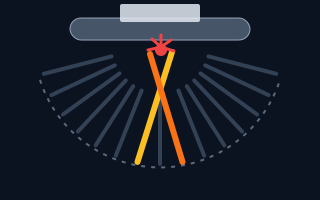
The inventors' initial euphoria soon gave way to the sobering reality of mechanical inadequacy. The core problem that plagued the early prototypes and would occupy Sholes for years was the constant jamming or sticking of the type bars. (Richard N. Current (1954), „The Typewriter and the Men Who Made It“) The cause lay in the design itself. The type bars were arranged in a basket or on a metal ring and had to fall back to their starting position solely by gravity after striking the paper. This process was sluggish. If a practiced typist pressed two keys whose levers were close together in the mechanism too quickly one after the other, the levers inevitably collided. The second lever jammed with the first before it could fall back, leading to a machine stoppage and often a double impression of the first letter. (Jimmy Stamp (2013), „The QWERTY Keyboard Will Never Die. Where Did the 150-Year-Old Design Come From?“)
This problem was particularly pronounced with the alphabetical layout. In English, many frequently used letters like 'A', 'B', 'C', 'D', and 'E' are close together in the alphabet, which led to constant jams during fast typing. (August Dvorak et al. (1936), „Typewriting Behavior“) Sholes and his partners recognized that a radical rearrangement of the keys was necessary. After numerous experiments, in which they, among other things, reversed the second half of the alphabet or moved the vowels to a separate row, they arrived at a counter-intuitive but effective solution. (Koichi Yasuoka & Motoko Yasuoka (2011), „On the Prehistory of QWERTY“)
The logic behind the QWERTY layout was purely mechanical and pragmatic. Instead of optimising the keys for people, the arrangement was optimised for the machine. According to the most common explanation, the idea was to separate frequent letter pairs (bigrams) in English, such as ‘th’, ‘he’, ‘er’ or ‘st’, on the keyboard. (Richard N. Current (1954), „The Typewriter and the Men Who Made It“) Ideally, the letters of such a pair would be typed with different hands or at least with fingers far apart on the same hand. The design imposed a certain rhythm on the typist and slowed down keystrokes in these critical combinations just enough for the first type bar to fall back before the second one moved. (Michael Adler (1973), „The Writing Machine“) The paradoxical aim was thus to increase overall writing speed by deliberately slowing down problematic sequences and eliminating time-consuming jams. (Charles E. Weller (1918), „The Early History of the Typewriter“) (Jimmy Stamp (2013), „The QWERTY Keyboard Will Never Die. Where Did the 150-Year-Old Design Come From?“)
A key figure in this optimization process was the investor James Densmore. He financed the development and acquired an ever-growing ownership stake. His brother, the educator Amos Densmore, is said to have influenced the arrangement with a study of frequent letter pairs – but this is not documented. (Wikipedia, „Sholes and Glidden typewriter“) (Wikipedia, „QWERTY“) The resulting QWERTY arrangement, first documented in a Sholes patent from 1878, was the result of this long evolutionary process. (U.S. Patent No. 207,559 (1878), „Type-Writing Machine“)
However, the 'jamming hypothesis' is not the only explanation for the layout's creation, and a critical look reveals a probably more complex reality. A plausible alternative theory, put forward by Japanese researchers Koichi and Motoko Yasuoka, points to the first professional users of the typewriter: the telegraphers. (Richard N. Current (1954), „The Typewriter and the Men Who Made It“) These individuals had to transcribe Morse code messages in real-time. The theory suggests that the QWERTY layout was optimized for their needs. This would explain some anomalies not covered by the jamming hypothesis. For example, 'E' and 'R', the fourth most frequent letter combination in English, are located right next to each other. (Koichi Yasuoka & Motoko Yasuoka (2011), „On the Prehistory of QWERTY“) However, the telegrapher theory offers an explanation for the strange proximity of 'Z', 'S', and 'E'. The Morse code for 'Z' (— · ·) and the letter sequence 'SE' (· · · ·) are very similar and could easily be confused. A close placement of these keys would have allowed a telegrapher to quickly correct an unclear transmission. (Koichi Yasuoka & Motoko Yasuoka (2011), „On the Prehistory of QWERTY“) This theory also contradicts the idea that the layout was intended to slow down typists, as telegraphers worked under intense time pressure.
A third, less scientific but often cited anecdote is the 'TYPE WRITER' legend. It suggests that the layout was designed so that salesmen could easily demonstrate the word 'typewriter' (or a variant thereof) using only the keys of the top row – a clever marketing trick. (Wikipedia, „QWERTY“) Although this story is likely apocryphal, it hints at an early awareness of the product's commercial presentation.
In the end, it is most likely that the emergence of QWERTY did not follow a single master plan but resulted from a synthesis of different influences. Avoiding mechanical jams formed the necessary technical basis. On top of that, the feedback and needs of the first important user group – telegraph operators – may have shaped the fine-tuning of the layout. Commercial considerations completed the process. QWERTY was therefore not the one perfect solution but a working compromise born of mechanical necessity, user-specific optimisation and early marketing thinking.
From Workshop to World Standard – The Decisive Role of Remington & Sons
Despite the technical advancements and the development of a functional layout, Sholes and his partners faced the biggest hurdle for any inventor: scaling from a working prototype to a mass-produced, commercially successful product. They lacked the capital and industrial infrastructure. The solution came in 1873: Densmore sold the manufacturing rights to E. Remington and Sons, an arms manufacturer looking to diversify that also built sewing machines. (Wikipedia, „QWERTY“) (Wikipedia, „Sholes and Glidden typewriter“) This decision was crucial because Remington possessed exactly what the inventors lacked: expertise in the precision manufacturing of metal parts, established production lines, and the capital to bear the risk of a market launch. (Richard N. Current (1954), „The Typewriter and the Men Who Made It“)
Remington’s engineers took over the prototype and prepared it for mass production. They refined the machine and finalised the key layout within a few months. One of the best-known changes: the 'R' moved to the position previously held by the period. Supposedly this let salesmen type the brand name ‘TYPE WRITER’ using only the top row – but this reason is not documented. The digits '1' and '0' were missing entirely; typists used the capital 'I' (or lowercase 'l') and the capital 'O' instead – a habit that persisted for a long time. (Wikipedia, „QWERTY“) (Charles E. Weller (1918), „The Early History of the Typewriter“)
On July 1, 1874, the result of this collaboration hit the market: the 'Sholes & Glidden Type Writer,' soon known as the Remington No. 1. (Wikipedia, „Sholes and Glidden typewriter“) Priced at $125 – roughly the average annual income per person at the time – the device was very expensive and still had considerable flaws. It could only type in uppercase letters and was a so-called 'blind writer' (up-strike mechanism), where the type bar struck the platen from underneath, so the typist could only see the typed text after having written several lines and lifting the carriage. (Wikipedia, „Sholes and Glidden typewriter“) The design was often decorated with floral ornaments, directly adopted from the company's sewing machines. This 'feminization' of the design may have unintentionally contributed to the early and lasting association of the typewriter with female office workers. (Michael Adler (1973), „The Writing Machine“) Accordingly, the initial sales success was modest. (Wikipedia, „Sholes and Glidden typewriter“)
The real breakthrough came in 1878 with the introduction of the Remington No. 2. This successor model not only fixed many of the mechanical flaws of its predecessor but also introduced a revolutionary innovation: the Shift key. A mechanism that raised or lowered the entire platen allowed switching between uppercase and lowercase letters for the first time. (Wikipedia, „Sholes and Glidden typewriter“) (Charles E. Weller (1918), „The Early History of the Typewriter“) This feature transformed the typewriter from a curiosity into a serious tool for everyday business. The success of the Remington No. 2 was the turning point that inextricably linked the QWERTY layout with the concept of professional writing. (Wikipedia, „QWERTY“)
Remington's strategy, however, went beyond mere product improvement. The company did not just sell machines; it created an entire ecosystem. They offered typing courses to train a new generation of professional typists. (Richard N. Current (1954), „The Typewriter and the Men Who Made It“) This created a strong network effect: the more people were trained on Remington machines with the QWERTY layout, the more companies felt compelled to buy exactly these machines to find qualified staff. This, in turn, increased the incentive for individuals to learn precisely this skill. (Stan J. Liebowitz & Stephen E. Margolis (1990), „The Fable of the Keys“) The crucial step towards cementing the standard occurred in 1893. Leading American manufacturers – Remington, Caligraph, Yost, Densmore and Smith Premier – joined together in the Union Typewriter Company trust. (Wikipedia, „Smith Corona“) This new market power established QWERTY as their uniform and sole industry standard, stifling any competition from alternative layouts in its infancy. (Richard N. Current (1954), „The Typewriter and the Men Who Made It“) The success of QWERTY was thus less a victory of the best technical design than a triumph of a superior business, manufacturing, and marketing strategy. Remington had not just sold a product but created a standard that became irreversible through control over production, training, and the market itself.
Beyond English – The Linguistic Adaptation of the Keyboard
The establishment of the QWERTY layout as the industry standard in the English-speaking world was only the first step in its global spread. As the typewriter began its triumphant advance around the globe, the layout designed for the English language quickly reached its limits. Every language has its own unique frequency of letters, characteristic letter combinations, and specific diacritical marks. A direct adoption of the QWERTY layout was therefore often inefficient or impractical. This led to the development of national variants that attempted to retain the basic structure of QWERTY but adapted it to the respective linguistic conditions. The most prominent examples of this adaptation process are the QWERTZ keyboard in the German-speaking area and the AZERTY keyboard in France and Belgium.
QWERTZ – The German Necessity
The most striking and important change to the German keyboard layout is the swap of the letters 'Y' and 'Z'. (DIN 2137-1:2012-06, Tastaturen für die Daten- und Texteingabe) This exchange is not an arbitrary decision but a direct consequence of the statistical realities of the German language. A frequency analysis shows that the letter 'Z' is very common in German, while 'Y' is a rarity and appears almost exclusively in foreign and loan words. (DIN 2137-1:2018-12, Tastaturen für die Daten- und Texteingabe) The standard QWERTY layout places the 'Y' in a prominent position easily reachable with the index finger, while the 'Z' is located in the bottom row on the far left, where it must be awkwardly typed with the little finger. The switch to the QWERTZ layout corrects this imbalance by moving the frequent letter 'Z' to the ergonomically more favorable position. (Friedrich Wilhelm Kaeding (1898), „Häufigkeitswörterbuch der deutschen Sprache“)
Furthermore, there are also orthographic and mechanical reasons for this adjustment. The letter combination 'tz', which is very common in German (e.g., in 'Katze', 'Satz', 'plötzlich'), can be typed more fluidly on a QWERTZ keyboard because the 'T' and 'Z' keys are now positioned so that they are usually struck with different hands. This reduced the risk of jamming on the original mechanical typewriters and also improves the typing flow on modern keyboards. (DIN 2137-1:2018-12, Tastaturen für die Daten- und Texteingabe) Likewise, typing the common word 'zu' is made easier by the immediate proximity of 'Z' and 'U'. (DIN 2137-1:2018-12, Tastaturen für die Daten- und Texteingabe)
Another indispensable adjustment was the integration of German special characters. The umlauts 'Ä', 'Ö', 'Ü', and the Eszett 'ß' are integral parts of German orthography and had to be directly accessible without cumbersome key combinations. They were therefore given their own dedicated keys, typically placed on the right side of the letter field. (Wikipedia, „QWERTZ“) To create space for these and other symbols without excessively enlarging the keyboard, the right Alt key on German keyboards becomes the 'Alt Gr' (Alternate Graphic) key. This key activates a third layer on many keys, enabling access to characters such as the at-symbol (@), the Euro sign (€), or square and curly brackets, which are essential for programmers and in technical correspondence. (DIN 2137-1:2018-12, Tastaturen für die Daten- und Texteingabe)
Finally, the labels of function keys were also adapted to the German language, so 'Ctrl' (Control) becomes 'Strg' (Steuerung/Control) and 'Del' (Delete) becomes 'Entf' (Entfernen/Delete). (DIN 2137-1:2018-12, Tastaturen für die Daten- und Texteingabe)
AZERTY – The French Variant
The French adaptation of the QWERTY layout, known as AZERTY, is even more radical. Here, not only two but four letters were swapped: 'A' and 'Q' as well as 'Z' and 'W' changed places. (AFNOR NF Z71-300 (2019), Claviers bureautiques) In addition, the letter 'M' was moved from its position next to 'N' to the position right of 'L'. The layout appeared in the 1890s as a variation of an older French arrangement; the exact reasons for the swaps are not reliably documented. (Wikipedia, „AZERTY“)
A more prominent feature of the AZERTY layout, however, is the prioritization of accents and special characters. In French, letters with diacritics such as 'é', 'è', 'ç', and 'à' are extremely common and essential for correct spelling. The AZERTY layout accounts for this by assigning dedicated, directly accessible keys to these characters. (AFNOR NF Z71-300 (2019), Claviers bureautiques) This prioritization goes so far that the digits in the top row are only accessible via the Shift key, while the base layer is reserved for accents and special characters – a compromise that places the needs of the French language above the universal convention of direct access to numbers. (AFNOR NF Z71-300 (2019), Claviers bureautiques)
Like the QWERTZ keyboard in Germany, AZERTY was also institutionally anchored. How firmly it is established is shown by the French standard NF Z71-300 of 2019: rather than abandoning AZERTY, it adds an optimised AZERTY variant that makes it easier to type accented capitals and the ligatures æ and œ. (AFNOR (2019), „Clavier français : une norme volontaire pour mieux écrire le français“) It is a clear example of how a global technology standard is adapted to local linguistic and cultural needs without changing its fundamental structure.
Comparison Table: QWERTY, QWERTZ, and AZERTY at a Glance
The following table summarizes the key differences between the dominant Latin keyboard layouts.
| Layout | Key Characteristic | Central Adaptations |
|---|---|---|
| QWERTY | Mechanical compromise layout to prevent colliding type bars. (Richard N. Current (1954), „The Typewriter and the Men Who Made It“) (Charles E. Weller (1918), „The Early History of the Typewriter“) | Top row for demonstration words like “TYPE WRITER” and simplified digit assignment. |
| QWERTZ | German-language variant with swapped Y/Z based on frequency analysis. (Friedrich Wilhelm Kaeding (1898), „Häufigkeitswörterbuch der deutschen Sprache“) | Dedicated keys for umlauts, Alt Gr layer for special characters according to DIN 2137. (DIN 2137-1:2012-06, Tastaturen für die Daten- und Texteingabe) (DIN 2137-1:2018-12, Tastaturen für die Daten- und Texteingabe) |
| AZERTY | French adaptation with shifted letters and focus on diacritics. (AFNOR NF Z71-300 (2019), Claviers bureautiques) | Accent keys prioritized, digit row by default only with Shift key according to NF Z71-300. (AFNOR NF Z71-300 (2019), Claviers bureautiques) |
Compilation based on DIN 2137 and AFNOR NF Z71-300. (DIN 2137-1:2012-06, Tastaturen für die Daten- und Texteingabe) (AFNOR NF Z71-300 (2019), Claviers bureautiques)
The Immortal Layout – Path Dependence and the Legacy of QWERTY

Perhaps the most fascinating question in the history of the keyboard is not how the QWERTY layout came about, but why it has persisted. The mechanical reasons for its existence – the sluggish, jamming type bars – have been obsolete since the introduction of electric typewriters and even more so since the advent of computer keyboards. (August Dvorak et al. (1936), „Typewriting Behavior“) Yet, this design, over 150 years old, continues to dominate our digital interaction unchallenged. The explanation for this phenomenon lies in a powerful socio-economic concept: path dependence.
Path dependence describes a process where early decisions, often random or made under specific historical conditions, shape the subsequent development path of a system so strongly that it is difficult or impossible to deviate from later on. This creates a “lock-in” effect, which binds the system to a particular solution, even when objectively better alternatives become available. (W. Brian Arthur (1994), „Increasing Returns and Path Dependence in the Economy“) The history of the QWERTY layout is the prototype of such a process.
Despite these immense forces of inertia, there have been serious attempts to break the tyranny of QWERTY. The two best-known challengers were the Dvorak and Colemak layouts.
The Dvorak Simplified Keyboard (DSK) was developed in the 1930s by Dr. August Dvorak and William Dealey on a scientific basis. After years of research on the English language and the ergonomics of typing, they designed a layout based on clear principles: the most frequently used letters and letter combinations should lie on the central 'home row' to minimize finger movement. Typing should alternate as much as possible between the left and right hands. The workload should be evenly distributed across all fingers, with the strongest fingers doing the most work. (U.S. Patent No. 2,040,248 (1936), „Typewriting Keyboard“) Studies conducted by Dvorak himself claimed dramatic increases in typing speed and a significant reduction in fatigue. Although the independence and methodology of these early studies are now controversial, it is undeniable that the Dvorak layout is ergonomically superior to the QWERTY layout. (August Dvorak (1943), „There Is a Better Typewriter Keyboard“)
A more modern challenger is the Colemak layout, published in 2006 by Shai Coleman. Colemak is designed as a compromise aimed at combining the ergonomic benefits of Dvorak with a lower learning barrier for QWERTY users. It also places the most frequent letters on the home row but changes only 17 keys compared to QWERTY. Crucially, it retains the positions of many non-alphabetic keys as well as those for important keyboard shortcuts like Ctrl+Z (Undo), Ctrl+X (Cut), Ctrl+C (Copy), and Ctrl+V (Paste). This is intended to ease the transition and maintain productivity when using software. (Shai Coleman (2006), Colemak Keyboard Layout)
Why have these objectively better alternatives failed? The answer lies in the power of path dependence. When Dvorak introduced his layout, the QWERTY ecosystem was already too strongly anchored. The switching costs were too high, the network effect too dominant. Despite their demonstrable ergonomic advantages, Dvorak and later Colemak never managed to gain traction in the mass market. They remained niche products for enthusiasts, programmers, and people seeking ergonomic solutions for chronic pain. (August Dvorak et al. (1936), „Typewriting Behavior“) How large that advantage really is remains disputed: Liebowitz and Margolis consider the early comparison studies methodologically weak and do not see QWERTY as a case of market failure (Stan J. Liebowitz & Stephen E. Margolis (1990), „The Fable of the Keys“). The history of keyboard layouts is therefore not only a technical but also a deeply human narrative about the power of habit, resistance to change, and the inertia of established systems. It teaches us a fundamental lesson about technological innovation: a new solution must not just be better; it must be radically and undeniably superior to overcome the immense inertia of a deeply entrenched standard. In socio-technical systems, the human and social factors are often more influential than purely technical progress.
- Network effects: Remington created a self-reinforcing system where every trained typist and every QWERTY machine sold increased the value of the entire network. (Stan J. Liebowitz & Stephen E. Margolis (1990), „The Fable of the Keys“)
- High Switching Costs: Millions of experienced typists would have had to accept enormous learning and productivity losses for a new layout. (Paul A. David (1985), „Clio and the Economics of QWERTY“)
- Muscle memory: Typing is deeply anchored in motor memory, which makes a layout change extremely frustrating and time-consuming. (Timothy A. Salthouse (1986), „Perceptual, Cognitive, and Motoric Aspects of Transcription Typing“)
- Established infrastructure: Manufacturers, repair shops, and teaching materials were completely geared towards QWERTY, leaving alternatives with little chance.
Bonus Material: Poster for Download
Do you want to have the most important development steps readily available at all times? Our poster summarizes the timeline, layout comparison, and key terms on a print-ready sheet.
Download Poster – Print-ready PDF (DIN A3) with timeline and layout highlights.
Place the printout next to your workstation or share the download with your team to initiate discussions about efficient keyboard work.
Conclusion: A 150-Year-Old Solution in a Digital World
The keyboard's evolutionary journey from a mechanical workaround to a global digital standard is one of the most captivating case studies in technological history. It begins with the ingenious, yet flawed, invention of Christopher Latham Sholes, whose team found a clever but counter-intuitive solution to a purely mechanical problem: the jamming of type bars. This solution, the QWERTY layout, was not tailored to human ergonomics, but to the limitations of the machinery of the time.
The decisive step towards global dominance occurred through commercialization and standardization by E. Remington and Sons. Through technical refinements such as the introduction of the Shift key, aggressive marketing strategies, and market consolidation, one of many possible designs became the undisputed industry standard. (Richard N. Current (1954), „The Typewriter and the Men Who Made It“) When the technology crossed the boundaries of the English-speaking world, it was adapted to the linguistic necessities of other languages, leading to the emergence of variants like QWERTZ in Germany and AZERTY in France – proof of the basic concept's adaptability to local needs. (DIN 2137-1:2018-12, Tastaturen für die Daten- und Texteingabe)
The unexpected longevity of this layout in the digital age, where the original mechanical problems no longer play a role, makes the keyboard a prime example of path dependence. The immense forces of habit, manifested in network effects, high retraining costs, and the deeply ingrained muscle memory of billions of users, have relegated even technologically superior alternatives like Dvorak and Colemak to their niches. (Paul A. David (1985), „Clio and the Economics of QWERTY“)
Anyone who wants to test concrete alternatives can find a data-based decision-making aid in our layout comparison – from ergonomic advantages to training strategies for switching. (Shai Coleman (2006), Colemak Keyboard Layout)
The QWERTZ/QWERTY keyboard on our desks is thus far more than just an input device. It is a living relic that reminds us daily that the tools we use often say more about our history, our economic structures, and our human psychology than about our tireless pursuit of perfect efficiency. It is a symbol of how the past shapes the present and how accidental decisions of yesterday can dictate the technological reality of today and tomorrow, even in the fastest-changing world humanity has ever known. (Paul A. David (1985), „Clio and the Economics of QWERTY“) How fast do you type on your current keyboard layout? Test your speed right now in our free online typing test or master proper finger placement with our touch typing guide.
References
The following sources are organized by primary and secondary literature and cover all citations in the article.
Primary Sources
- U.S. Patent No. 79,265 (1868) – Improvement in Type-Writing Machines – Sholes, Glidden & Soule, 23. Juni 1868.
- Scientific American (1872) – The Type Writer – Vol. 27, No. 6, 10 August 1872.
- U.S. Patent No. 207,559 (1878) – Type-Writing Machine – Christopher Latham Sholes, 3. September 1878.
- Charles E. Weller (1918) – The Early History of the Typewriter – Chase & Shepherd, La Porte, Indiana, 1918.
- U.S. Patent No. 2,040,248 (1936) – Typewriting Keyboard – August Dvorak et al., 12. Mai 1936.
- DIN 2137-1:2012-06 – Tastaturen für die Daten- und Texteingabe – DIN Media, Berlin, 2012.
- DIN 2137-1:2018-12 – Tastaturen für die Daten- und Texteingabe – DIN Media, Berlin, 2018 (superseded by DIN 2137-1:2023-08).
- Friedrich Wilhelm Kaeding (1898) – Häufigkeitswörterbuch der deutschen Sprache – Steglitz, 1897/98.
- AFNOR NF Z71-300:2019 – Claviers bureautiques – dispositions des caractères – Association Française de Normalisation, Paris, 2019.
- Shai Coleman (2006) – Colemak Keyboard Layout – Colemak.com, Version 1.0.
Secondary Literature
- Paul A. David (1985) – Clio and the Economics of QWERTY – American Economic Review 75(2), S. 332–337.
- Richard N. Current (1954) – The Typewriter and the Men Who Made It – Harvard University Press, Cambridge (MA).
- W. Brian Arthur (1994) – Increasing Returns and Path Dependence in the Economy – University of Michigan Press, Ann Arbor.
- Stan J. Liebowitz & Stephen E. Margolis (1990) – The Fable of the Keys – Journal of Law & Economics 33(1), S. 1–25.
- Michael Adler (1973) – The Writing Machine – George Allen & Unwin, London.
- Koichi Yasuoka & Motoko Yasuoka (2011) – On the Prehistory of QWERTY – ZINBUN 42 (2011), pp. 161–174, Kyoto University.
- August Dvorak, Nellie Merrick, William Dealey & Gertrude Ford (1936) – Typewriting Behavior – American Book Company, New York.
- August Dvorak (1943) – There Is a Better Typewriter Keyboard – National Business Education Quarterly 12(1), S. 51–58.
- Timothy A. Salthouse (1986) – Perceptual, Cognitive, and Motoric Aspects of Transcription Typing – Psychological Bulletin 99(3), pp. 303–319.
- Wikipedia – Sholes and Glidden typewriter, accessed 28 Sep 2026.
- Wikipedia – QWERTY, accessed 28 Sep 2026.
- Wikipedia – Christopher Latham Sholes, accessed 28 Sep 2026.
- Jimmy Stamp (2013) – The QWERTY Keyboard Will Never Die. Where Did the 150-Year-Old Design Come From? – Smithsonian Magazine, accessed 28 Sep 2026.
- Wikipedia – Smith Corona, accessed 28 Sep 2026.
- Wikipedia – AZERTY, accessed 28 Sep 2026.
- AFNOR (2019) – Clavier français : une norme volontaire pour mieux écrire le français, accessed 28 Sep 2026.
- Wikipedia – QWERTZ, accessed 28 Sep 2026.
How fast do you type right now?
Measure your WPM and accuracy in 60 seconds – free and without signing up.
Start the typing test now